Cabinet factories usually buy PVC edge banding as a production material, not as a decorative accessory. The right roll must match the board surface, feed smoothly on automatic machines, bond well with EVA or PUR glue, and stay stable when the same cabinet color is reordered months later.
This guide explains the practical specification points a cabinet factory should confirm before buying edge banding in bulk from China.
Start with the cabinet board, not the roll
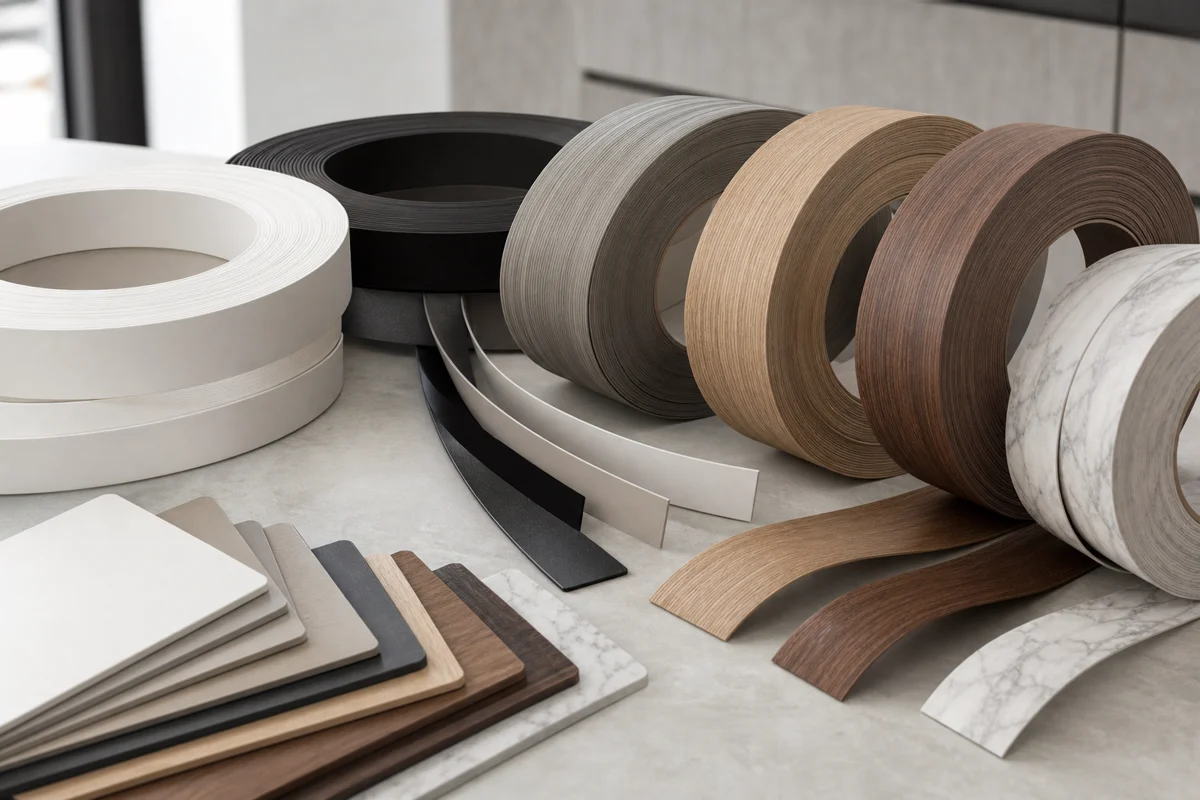
The board surface decides the edge banding specification. A high-gloss door needs a gloss-matched edge; a super-matte board needs low reflection and anti-fingerprint behavior; wood grain boards need decor direction, print tone, and texture checked together.
Before quotation, send board brand, decor code, panel thickness, required edge thickness, and whether the edge is used on visible door fronts, carcass panels, drawer boxes, or shelves.
Thickness and width for cabinet production
Most cabinet doors use 1mm or 2mm PVC edge banding. Thin 0.4-0.5mm banding is common for carcass parts and lower-cost furniture, while 2mm is preferred for doors and visible impact areas. Width should cover the board thickness plus trimming allowance.
For 18mm panels, 22mm edge banding is often more practical than exact 18mm width because the trimming unit needs clean overhang on both sides.
Color and gloss approval workflow
Approve color under daylight and indoor light. Check the board face and the edge together after trimming, because the visible edge after machining may look different from the roll surface. Keep one signed master sample for future repeat orders.
If the board supplier changes the decor batch, request a quick recheck before repeating the edge banding order.
Machine and adhesive notes
Tell the edge banding supplier the machine brand, line speed, glue type, glue temperature, and trimming system. Homag, Biesse, SCM, IMA, Brandt, and Holzher machines can all run PVC banding, but feed stability depends on winding, thickness tolerance, and back treatment.
Kitchen and bathroom cabinets often benefit from PUR adhesive, while standard wardrobes and office furniture commonly use EVA hot melt adhesive.
Ordering plan for cabinet factories
A safe order plan separates stock colors, project colors, and custom matched colors. For stock colors, MOQ can stay lower. For project colors, reserve extra material for replacements and after-sales service. For custom colors, lock a master sample and batch number.
JINYOU supports cabinet factories with samples, color matching, mixed-color wholesale orders, export cartons, and repeat order references.
Quick reference table
| Cabinet part | Typical edge banding | Buyer note |
|---|---|---|
| Door fronts | 1mm or 2mm PVC | Match color, gloss, texture and board decor |
| Carcass panels | 0.4mm to 1mm PVC | Control cost while keeping clean trimming |
| Shelves | 1mm or 2mm PVC | Choose stronger thickness for visible and high-use edges |
| Bathroom cabinets | PVC with PUR adhesive | Better moisture resistance at the glue line |
FAQ
What thickness PVC edge banding is best for cabinet doors?
For most cabinet doors, 1mm is a balanced standard and 2mm is preferred for premium or high-impact visible edges. Carcass panels often use 0.4-0.5mm or 1mm.
Should cabinet factories approve physical samples?
Yes. Physical samples should be checked on the actual board surface after trimming and viewed under daylight and indoor light before bulk production.
Can JINYOU match cabinet board colors?
Yes. JINYOU can match solid colors, wood grain, gloss level, and texture using board codes, Pantone/RAL references, or physical samples.
Need PVC edge banding for a real order?
Send thickness, width, color, finish, quantity, packing request, and destination country.
Contact JINYOU